Bhagavad Gita Chapter 4 Verses 14 to 15 Self-Knowledge Provides Freedom from the Effects of Action
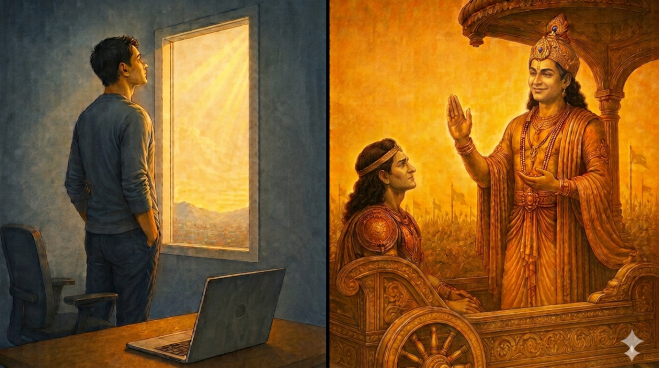
Right action performed with the right attitude purifies the mind and prepares it for Jñānam, which ultimately gives Moksha. The pursuit of Moksha does not necessarily require one to renounce family and social life. The Shastras outline a framework for individual spiritual progress while living as part of society.
Having referred to this social framework, Lord Krishna goes on to state that He too, like everything else in the universe, is engaged in continuous action, yet remains unaffected by action or its results. This freedom comes from Self-knowledge — the knowledge that releases one from the binding effects of action.
Self-knowledge is the central teaching of the Bhagavad Gita and an important focus of Chapter 4. Verses 14 and 15 begin to show how such knowledge allows one to remain active in the world without being bound by action.
Krishna states: “Actions do not affect Me” (karmāṇi māṁ na limpanti). Actions do not create tension, anxiety or similar disturbances in Him.
He also says: “I have no longing for the results of action” (na me karma-phale spṛhā). Krishna has no anxiety regarding the outcome.
While the Lord effortlessly remains in this state, a seeker should understand that, as a result of action, one gets what one deserves, not necessarily what one desires. The Lord, as the giver of the results of action in accordance with the Law of Karma, is just.
To avoid turning this understanding into fatalism, an active Gṛhastha seeker must recognise that planning for a result and worrying about a result are different.
Planning is a deliberate action. One can decide: “I will think about this issue from 5:00 to 5:30.” It can be started and stopped deliberately. Vedanta is never against planning. Planning is encouraged because it makes one more efficient in working towards the desired result.
Worrying is different. It is not a deliberate action, but a helpless happening. It continues even when one does not want it to. Worrying about the result serves no purpose and makes one inefficient in the present while performing the action.
Planning leads to efficiency; worrying leads to deficiency.
When Krishna says that He has no craving for the fruits of action, this applies even in the context of the Mahabharata war. He remains free from anxiety about its outcome because of Self-knowledge.
Krishna extends this possibility to the seeker when He says: “One who knows Me in this manner…” (māṁ ya evam abhijānāti) and concludes, “Such a person is not bound by actions” (sa karmabhir na badhyate).
Such a person understands the secret of freedom in spite of activity.
It is not freedom from activity. It is not freedom from responsibility. It is freedom in spite of activity and responsibility.
Just as Bhagavān is not bound by His actions, a wise person — a Jñāni — is also not bound by action.
In verse 15, Lord Krishna tells Arjuna that this knowledge is neither new nor merely theoretical. Seekers of earlier generations had understood and lived this teaching.
“Having known thus, the seekers of liberation of the past performed action” (evaṁ jñātvā kṛtaṁ karma pūrvair api mumukṣubhiḥ).
They gained Self-knowledge and, even after gaining that knowledge, continued to perform action. They remained active in the world.
Krishna then tells Arjuna: “Therefore, you too perform action” (tasmāt tvam api karmaiva kuru). In Arjuna’s case, this means remaining in the householder’s stage of life — Gṛhastha Āśrama — rather than seeking renunciation as an escape from the unpleasant action before him. He must fight the war.
Krishna further asks Arjuna to perform the kind of action undertaken by those before him: “The action performed by the ancients” (pūrvaiḥ pūrvataraṁ kṛtam). In Arjuna’s particular case, this means continuing with the profession and duty associated with his lineage. A lineage-based profession is thus being prescribed for Arjuna.
For a Gṛhastha Seeker
Life inevitably involves action. The Vedic lifestyle provides a framework in which material desires, social responsibility and spiritual growth can coexist. The social system — Varṇa — supports social harmony, while the life-stage system — Āśrama — supports individual spiritual growth.
Krishna performs immense action and remains unbound, and a knowledgeable person can do the same. The goal is not freedom from action, but freedom while acting.
On the spiritual path, this is a dilemma that a seeker can easily face. One turns to a Guru who is often a renunciate — someone who has given up worldly pursuits for Sādhana and scriptural study. I remember that, very early in my school days, I had a question: why go through life at all if one must ultimately seek freedom from it?
With this teaching, the Gita puts this conflict to rest. It assures a Gṛhastha that Moksha is realizable while leading an ordinary day-to-day life. The freedom one seeks is not obtained by escaping life, but through the Self-knowledge that leaves one free even while fully participating in it.